Choosing a large display for education and meeting spaces has long left buyers caught between two difficult options.
Buyers want large screens at a balanced cost, yet projection struggles with ambient light, IFPDs are constrained by size and the difficulty of getting them through doorways, and low-priced LED carries the hidden risk of frequent failures and heavy maintenance. Push the budget into premium territory, and the market answers with a dizzying array of display specs, interaction specs, and smart features that make it hard to identify quickly which screen actually fits. Investment and real need drift apart. This mismatch is playing out across a market for education and meeting displays now approaching RMB 10 billion.
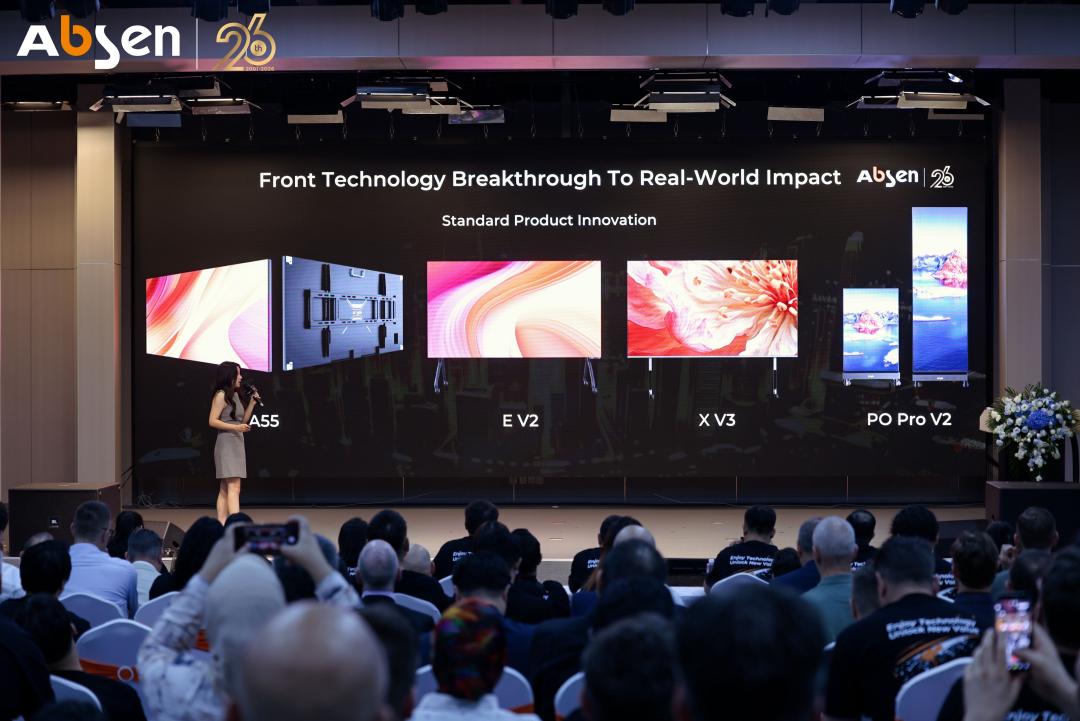
At its global technology launch event under the theme “Enjoy Technology, Unlock Value,” Absen officially introduced two new products to users worldwide: the iCon X V3 series, the world’s first native multimodal AI + MicroLED interactive display terminal, and the iCon E V2 series, a high-efficiency, low-power MicroLED interactive display terminal built for education and meeting environments—offering a new way to think about a contradiction the industry has lived with for years.
In a Market Approaching RMB 10 Billion, Different Scenarios, Different Needs
Three segments—education projectors above 100 inches, education interactive flat panels, and meeting interactive flat panels—together approach RMB 10 billion, according to commercial display market forecasts. The market is large enough, and the complaints are consistent: screens that wash out with the lights on, back rows that cannot see, oversized units that are hard to get through a door, and electricity bills that add up. These are heard repeatedly in classrooms and meeting rooms. LED direct view is seen as the alternative precisely because it still has clear headroom in brightness, size, and lifespan.
Yet the real headache is choosing which screen to buy. Within the same education and meeting context, needs differ.
One set of needs comes from K12 classrooms, training rooms, and small and mid-sized meeting rooms, where the screen is a core everyday need. The requirements are practical and clear: a solid, dependable display that stays readable with the lights on, starts up fast, keeps electricity costs manageable, fits in an elevator and can be moved when needed, and withstands the knocks of busy, high-traffic environments.
Another set of needs comes from premium conference halls, medical teaching rooms, corporate headquarters boardrooms, and five-star hotel ballrooms, where the emphasis is on a richer, multi-faceted experience. For these users the screen is a productivity tool, and picture detail, interaction fluidity, response latency, and the finished look of the installation are each examined closely. A screen in that room often represents the organization’s professionalism and taste.
A third factor is reshaping how everyone makes this decision: AI.
By 2026, there is no discussing large displays without AI. The problem is that nearly every brand now calls itself an “AI smart screen,” leaving buyers unable to tell what the AI actually does. Can it only understand “turn on the screen,” or can it understand “get the materials ready for this afternoon’s briefing”—or even learn on its own and keep improving? The market lacks an intelligence rating standard that lets buyers match a product to their needs.
Two Series, Two Answers
Absen’s approach is straightforward. The two series are positioned to complement each other, each addressing the core needs of a different scenario, with optional configurations covering more specific requirements.
iCon X V3 Multimodal Agent Interactive Terminal: Designed to Belong in the Space
The iCon X V3 series is Absen’s newly launched, world’s first native multimodal AI + MicroLED interactive display terminal. It is aimed at premium conference halls, medical teaching rooms, corporate headquarters boardrooms, and five-star hotels, where users judge a display by whether it can merge with the surrounding space and support a wider range of interactions—the direction premium commercial displays are moving.
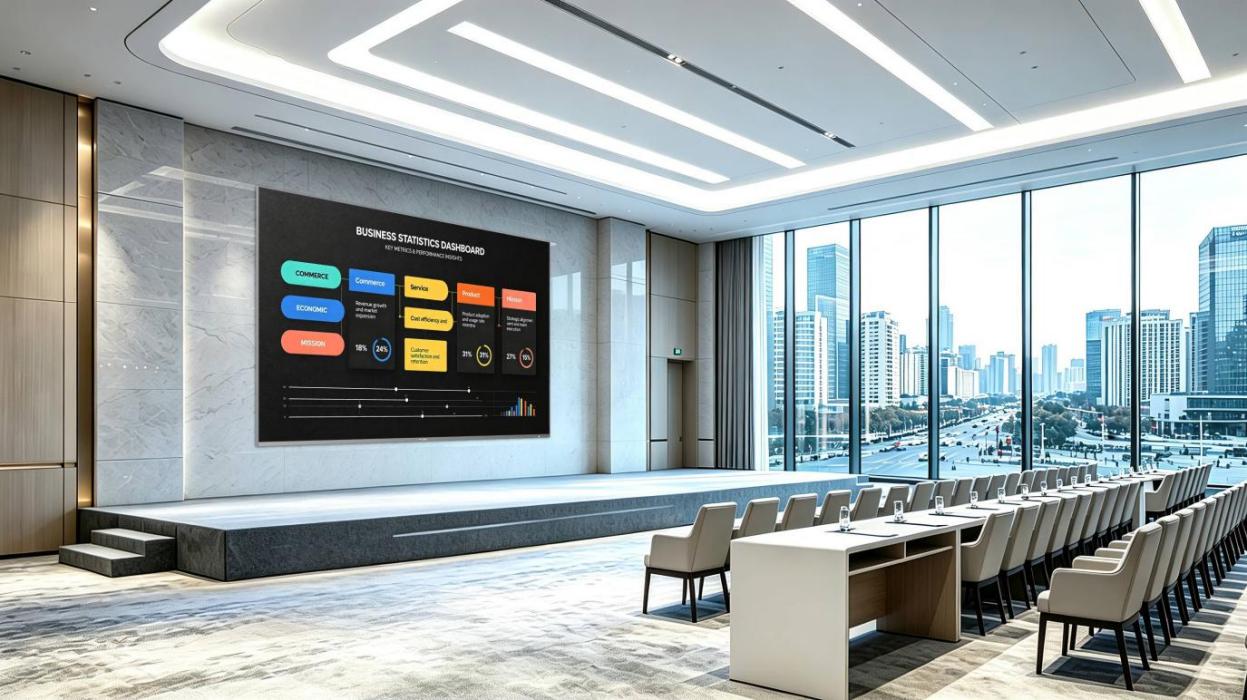
(Application scenario illustration)
In terms of visual and spatial integration, the iCon X V3 pairs an 18mm ultra-slim profile with a 98% screen-to-body ratio in a minimalist design that sits naturally alongside the materials and lines of premium meeting rooms and hotel ballrooms. Across the series, a 7680Hz scan refresh rate, 120Hz high frame rate video, and 2-frame imperceptible system latency combine with 4-trillion-color precision to keep transitions between light and dark true to the source and eliminate motion blur in professional presentations.
On interaction, beyond the established capabilities of touch, screen casting, and multi-signal input, the iCon X V3 series is the first to integrate Absen’s self-developed AI agent, Acube (Beta), making it the world’s first native multimodal AI + MicroLED interactive display terminal—another step that puts Absen at the front of the industry in intelligent displays.
iCon E V2 Interactive Display Terminal: Getting the Fundamentals Right
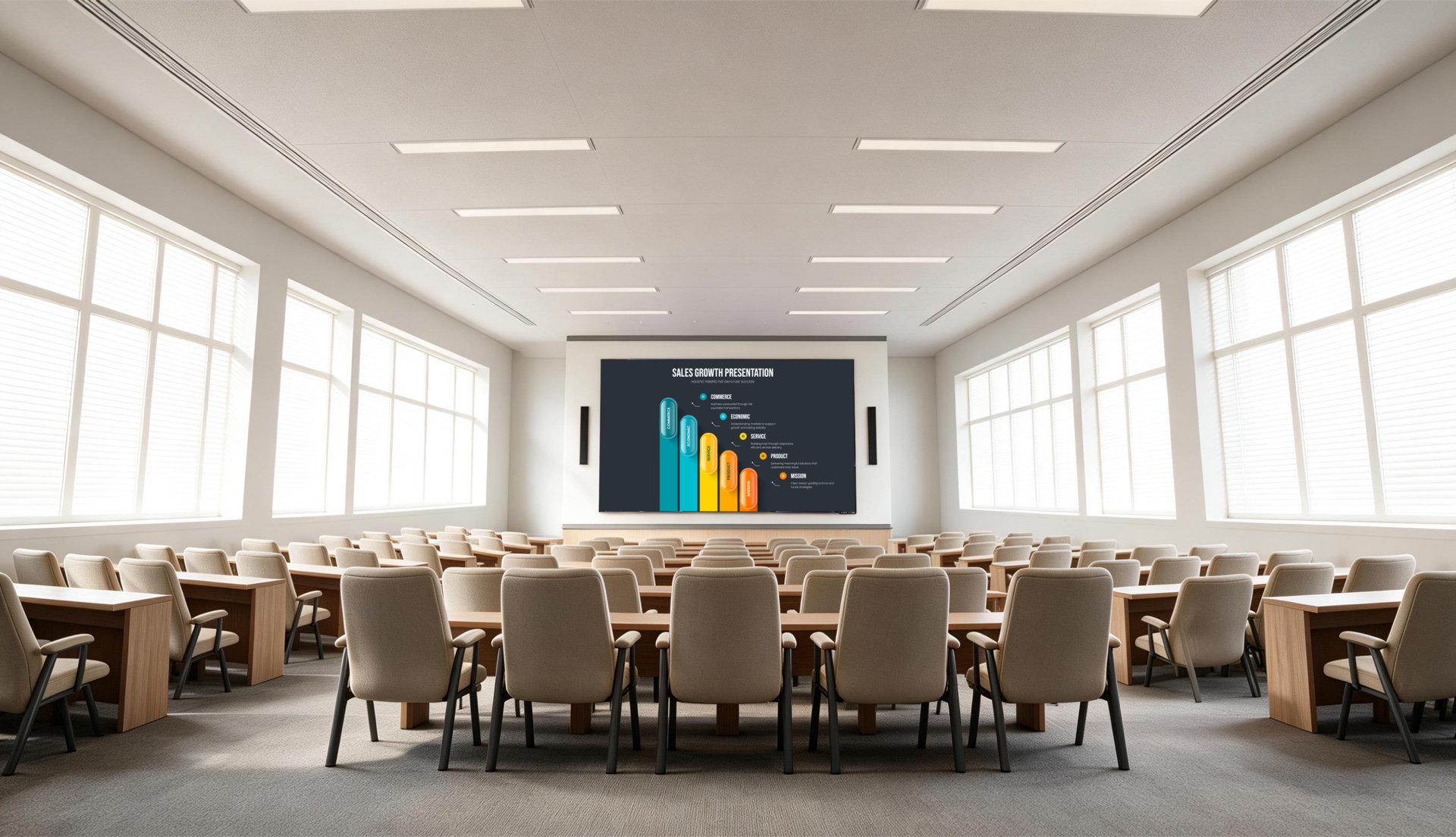
The iCon E V2 targets K12 classrooms, training rooms, and small and mid-sized meeting rooms. Its core breakthrough is the alignment of price and picture quality: at the same size, the iCon E V2 delivers MicroLED-level display quality at a price comparable to LCD and SMD LED screens, so users no longer have to choose between budget and image quality.
(Application scenario illustration)
The design logic behind the iCon E V2 is to take the fundamentals users care about most and do them thoroughly. A 600nit brightness paired with a 160° ultra-wide viewing angle keeps the image clear under natural daylight, so classrooms no longer need to draw the curtains for projection, while back rows and side seats get a stable view. A rich set of ports and three-way split-screen plug-and-play keep the core casting workflow in lessons and meetings smooth and efficient. A column-split shipping form factor removes the bottleneck of moving large equipment, allowing transport and installation through a standard elevator.
As for electricity costs, take the E130 V2: with average power consumption as low as 426W, running 8 hours a day and standing by for 16, the daily electricity cost comes to roughly RMB 2, substantially lowering operating costs over time. Beyond features, the iCon E V2 carries Absen’s consistent quality standards, with CCC certification, low blue light certification, and other authoritative approvals, suited to complex, high-traffic, multi-user environments.
In short, the iCon E V2 interactive display terminal does not pile on concepts. It puts its effort where users meet it every day.
How Smart Should an AI Agent Be? Set a Standard, Play a Trump Card
This is the main event.
The SAE autonomous driving levels are widely trusted across the global industry because they are built on the division of responsibility between human and machine, with clearly defined boundaries, long engineering validation, and a rigorous, mature framework. In today’s AI display sector, by contrast, no unified standard has emerged, and many products wear the smart screen label on the strength of basic AI features alone, making real capability hard to judge.
Absen borrowed that grading logic to build an L0–L5 intelligence framework purpose-built for the LED industry, putting large display AI capability on a scale. With it, users can read where a product stands today and see the path ahead.
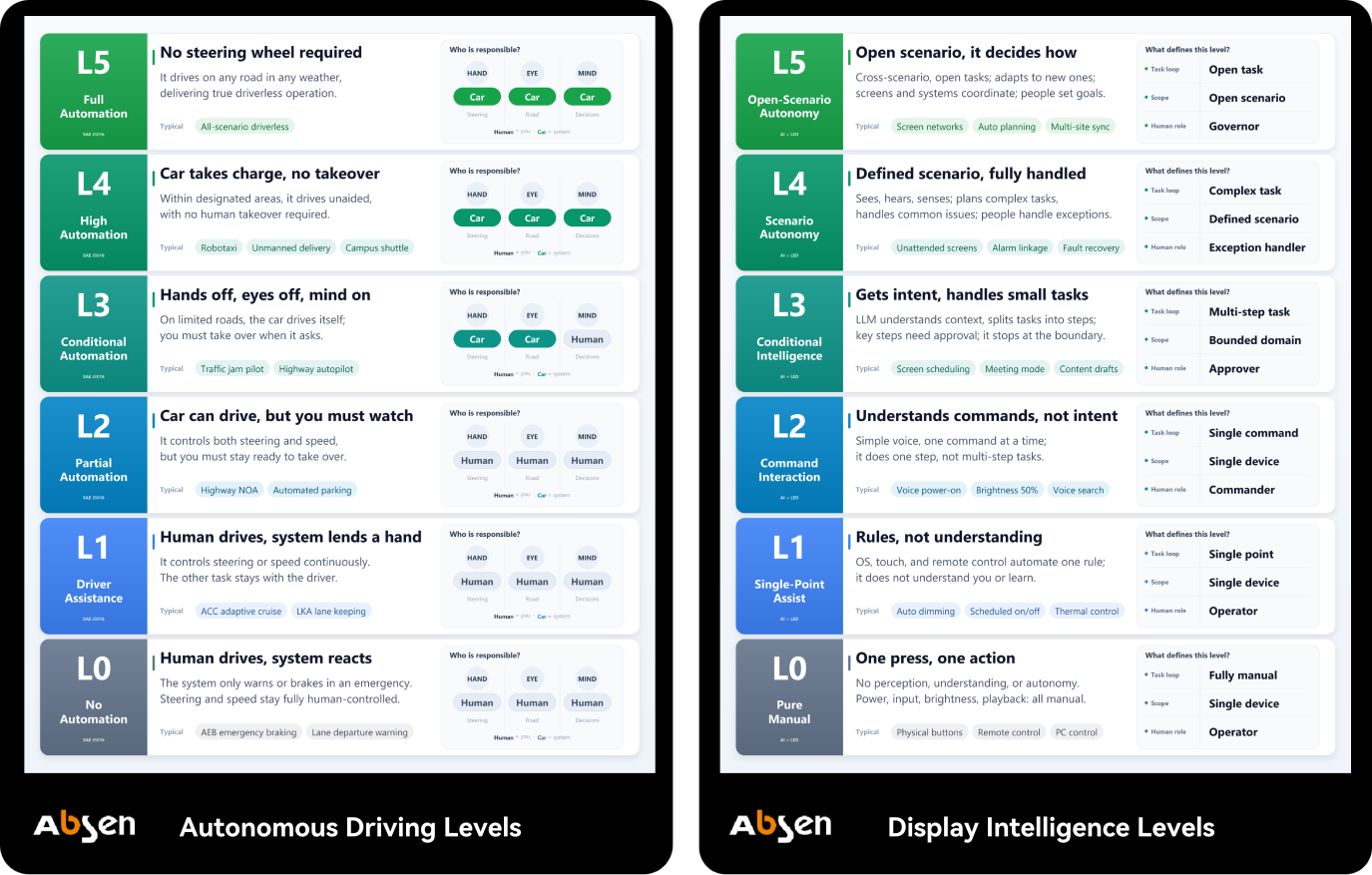
As Absen’s native multimodal AI system, Acube (Beta) sits at L2–L3. It understands image, sound, and semantics within a single system, supports multiple languages, recognizes user intent, and can keep learning on its own. Through conversation alone, users can have Acube (Beta) handle single-command tasks such as calling up system functions, selecting files, operating features, simultaneous interpretation, and meeting notes. Drawing on its own learning and comprehension, it can also break down and complete more complex work such as live on-screen translation, automatic minute generation, and automatic quiz generation.
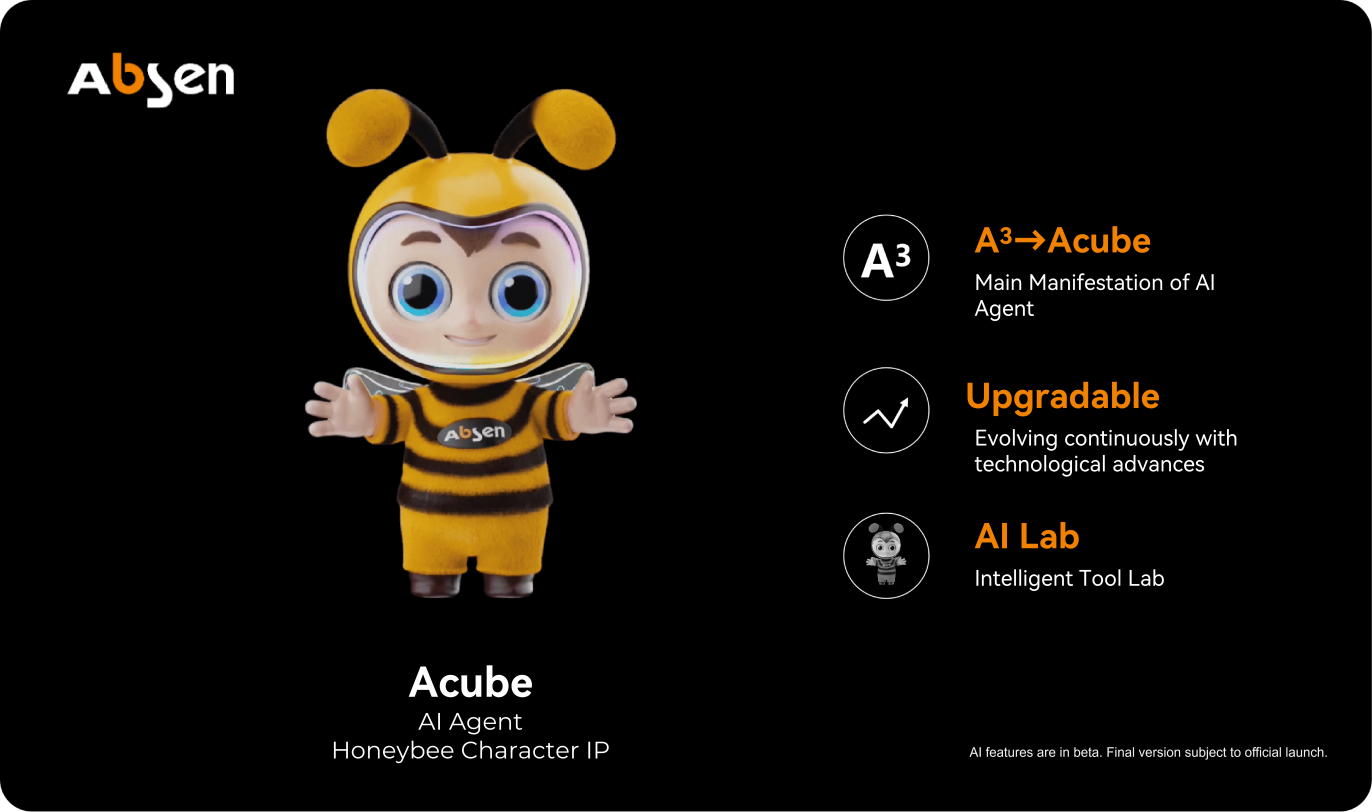
Acube (Beta) is currently in public beta, with the experience improving continuously. A formal release is planned for 2027, with further evolution toward L4 and broader support across display platforms.
Faced with the varied needs of the education and meeting market, the iCon E V2 interactive display terminal puts every yuan of budget where it counts, while the iCon X V3 multimodal agent interactive terminal lets the screen truly merge into the environment and grow with its users. More individualized needs are covered by optional configurations.
So how do you choose an AI-powered display? Absen’s L0-to-L5 path brings a clear standard into the LED industry and gives buyers a clearer way to choose—no guesswork, just one table to find the smart display they need faster.
Absen is committed to making sure every classroom and every meeting room can find the screen that fits it best, and to making the whole experience of choosing a display simple again. Technology keeps moving, and AI keeps evolving. The best products do not ask users to learn and adapt to them; they settle quietly into the setting and into people’s habits.