As global digitalization and intelligent transformation continue to deepen, the role of display devices is shifting: from traditional information output tools to core visual terminals and gateways for data interaction within the digital ecosystems of countless industries. With the growing demand for ultra-high-definition applications, LED fine-pitch displays—thanks to their seamless splicing, high brightness, high reliability, and flexible deployment—have firmly secured a central position in the commercial UHD display market.
Against this backdrop, Absen has officially released the COB Fine-Pitch Display Product Technology Development White Paper. The white paper traces three decades of technological evolution in the LED display industry and the evolution of COB technology. Drawing on Absen’s decade-long technology expertise and real-world benchmark projects both domestically and globally, it analyzes the underlying drivers behind the rise of COB fine-pitch displays, technological upgrades, and future trends—offering a practical reference for product selection, project bidding, and corporate R&D.
01 Process Innovation Reshapes the Industry, COB Fine-Pitch Enters a New Phase of Large-Scale Adoption
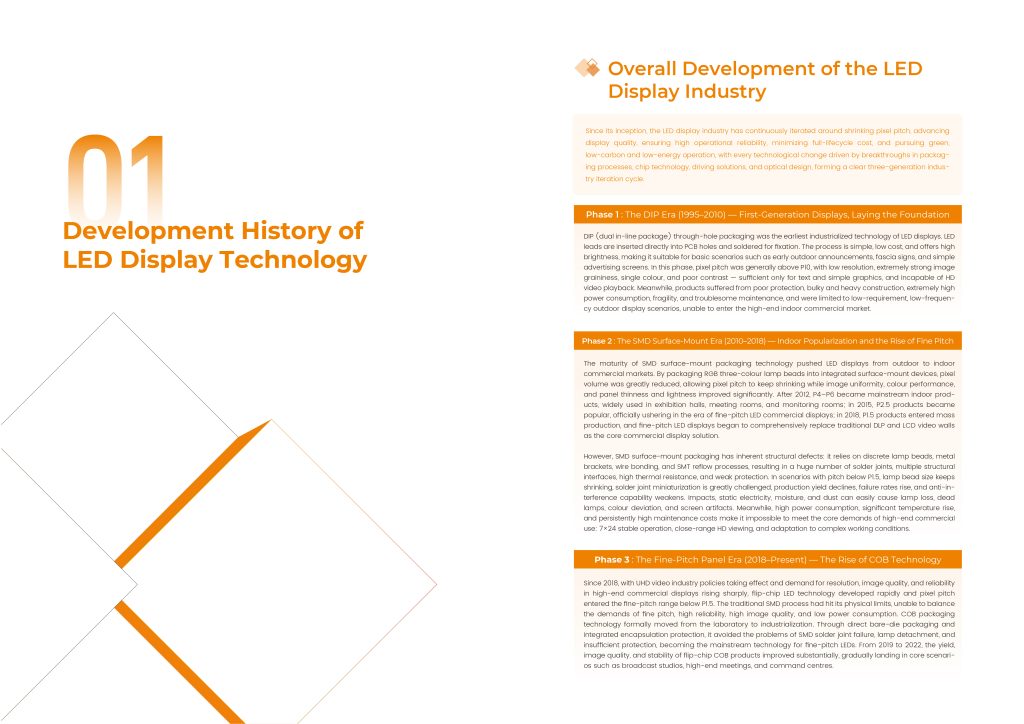
Looking back at the three major generational shifts in the LED display industry, every transformation has been driven by breakthroughs in packaging processes, chip technology, driver solutions, and optical design. From early LED displays to fine-pitch LEDs, and now to the steadily maturing COB technology, display products have continuously pushed boundaries in pixel pitch, image quality, protection, reliability, and application scenarios. Behind this progression lies a clear industry pattern: when a previous generation of technology approaches its performance and application limits, market demand naturally gives rise to a new technological path.
From a manufacturing perspective, SMD requires multiple steps—LED lamp packaging, inspection and sorting, taping, SMT placement, reflow soldering, and more—resulting in numerous layered interfaces and potential failure points within the product. COB, in contrast, transforms the conventional packaging approach, centering on high-precision die-bonding and integral encapsulation to dramatically simplify the product structure. This process change is not merely about “eliminating a few steps”; it fundamentally reshapes the product’s underlying architecture: more integrated structure, more direct thermal paths, more comprehensive protection, and more uniform optical performance.
With traditional SMD fine-pitch displays, the solder joints of the LED packages are an inherent weak point. As pixel pitch continues to shrink, solder joint density surges, making the joints more vulnerable to moisture, vibration, and thermal expansion and contraction, all of which can cause LED package failure. COB, by directly bonding chips to the substrate and encapsulating both chips and circuits in an integral package, fundamentally reduces the risk of solder joint failure and offers inherent advantages in dust and moisture resistance, mechanical shock tolerance, and black-state image consistency. This is precisely the technical reason why COB is well-suited for demanding applications such as rail transit.
From an industry development perspective, this trend has been fully validated by the market, and the development direction of fine-pitch displays is increasingly clear:
- COB P0.9 displays have become mainstream, with COB P0.6 displays achieving commercial deployment.
- Chips, driver ICs, PCB substrates, encapsulation materials, control systems, and automation equipment have achieved full localization across the entire domestic supply chain.
- Applications have expanded from premium specialized sectors to government and enterprise, education, healthcare, transportation, retail, and XR virtual production.
The convergence of process innovation, supply chain maturity, and expanding application scenarios signals that COB displays have entered a new phase of large-scale development. At the same time, this raises the bar for technical depth and real-world deployment capabilities across the industry.
02 A Decade of Dedication: Sustained Investment Forges Core COB Capabilities
The white paper uses Absen’s COB technology innovations as a case study, demonstrating how the company builds product technology leadership by addressing real-world application needs.
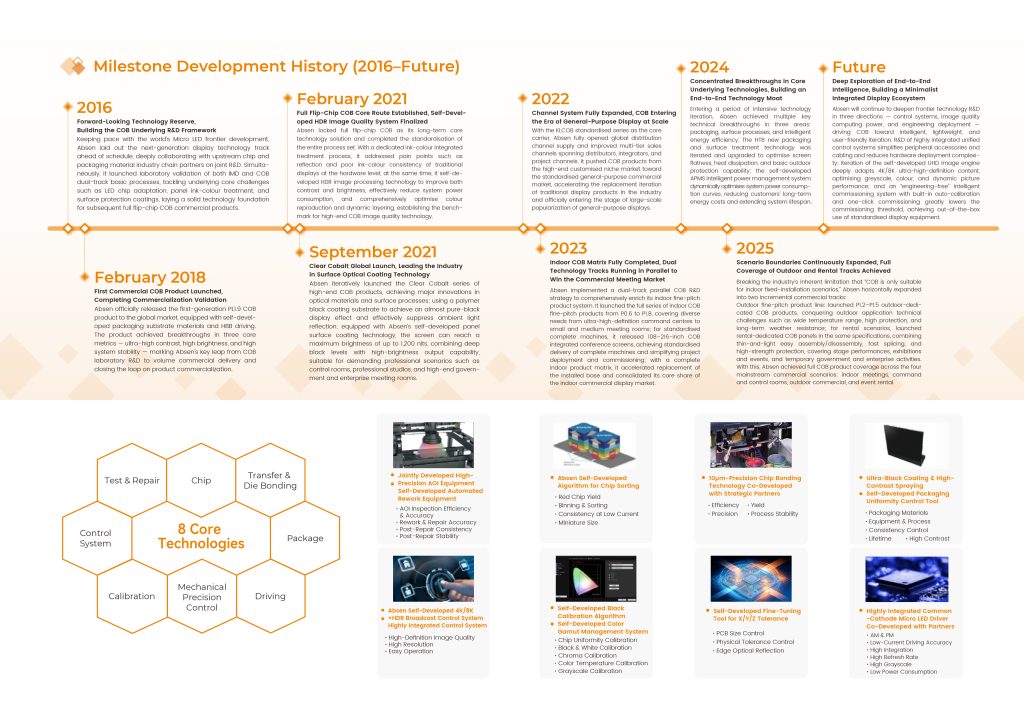
Beginning with forward-looking technology development in 2016 and the establishment of a foundational COB R&D framework, Absen embarked on a long-term technology journey. In 2018, it achieved the first commercial deployment of a COB product, marking the critical transition from the laboratory to commercial validation. In 2021, Absen formally established flip-chip COB as its core technology path, simultaneously achieving major breakthroughs in HDR image quality technology and Clear Cobalt optical coating technology. Over years of iteration, Absen has progressively developed eight core technology systems—covering packaging processes, chips, drivers, mechanical precision control, calibration, control systems, testing and maintenance, and transfer and die-bonding.
The flip-chip COB path further unlocks technical potential: flip-chip technology eliminates pad obstruction, enabling higher contrast, while also optimizing thermal pathways to effectively reduce the system’s temperature rise, providing a solid hardware foundation for long-term, stable, uninterrupted operation.
As the industry enters a phase of large-scale commercialization, these accumulated technological capabilities continue to deliver value. Leveraging its COB technology advantages, Absen continues to drive down total cost of ownership (TCO) while redefining the value equation for display products: Display Value = Image Quality × Reliability × Longevity.
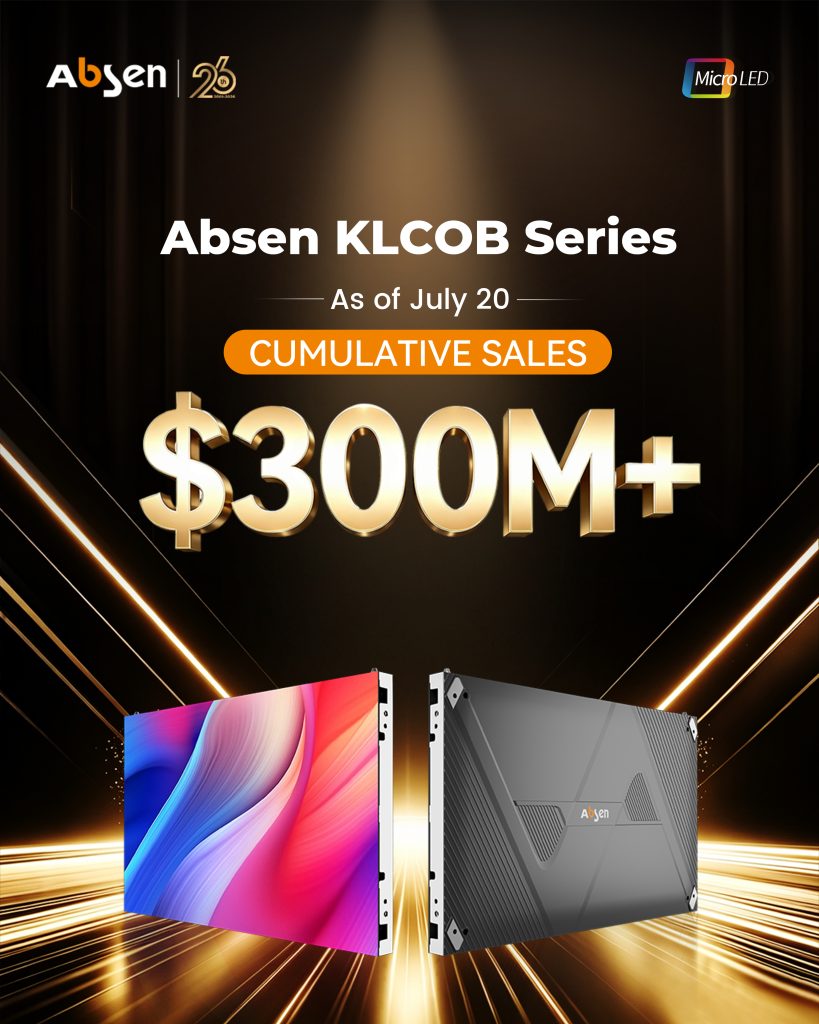
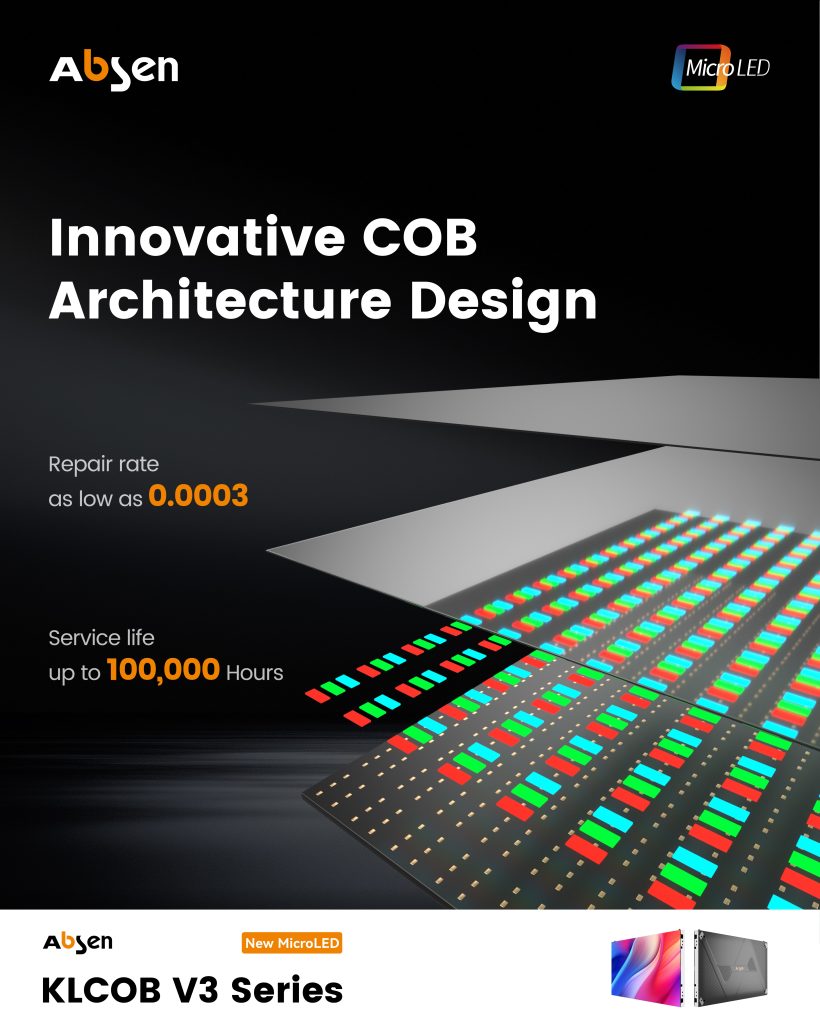
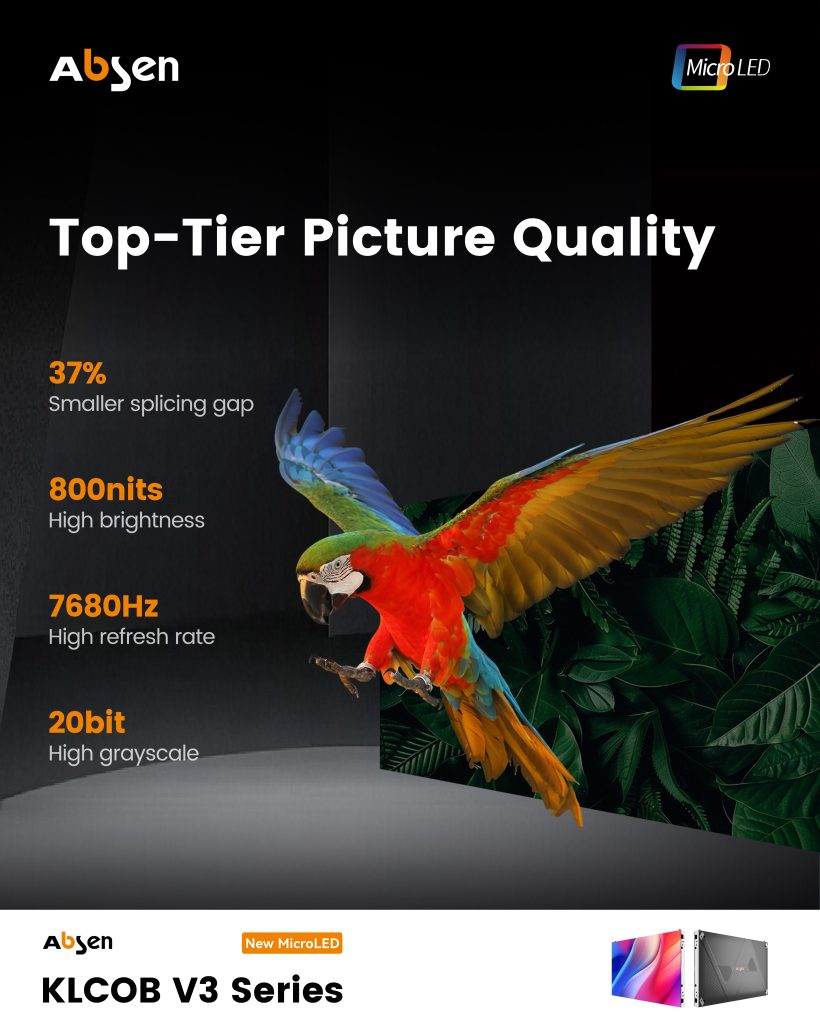
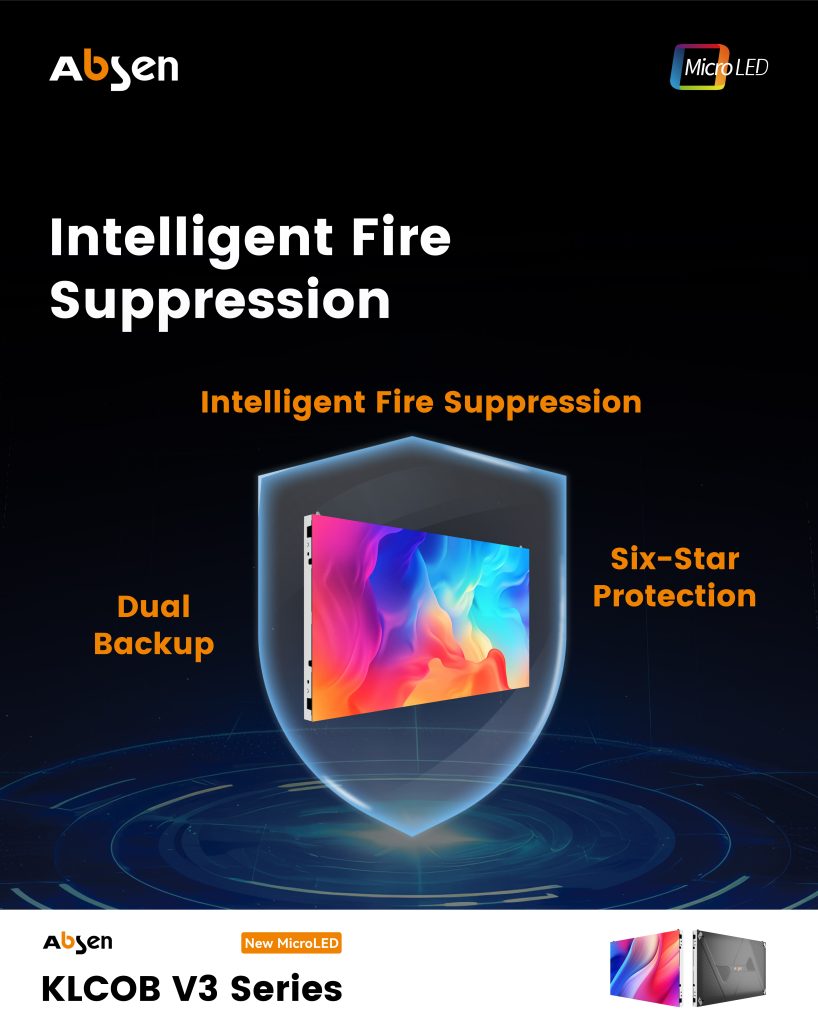
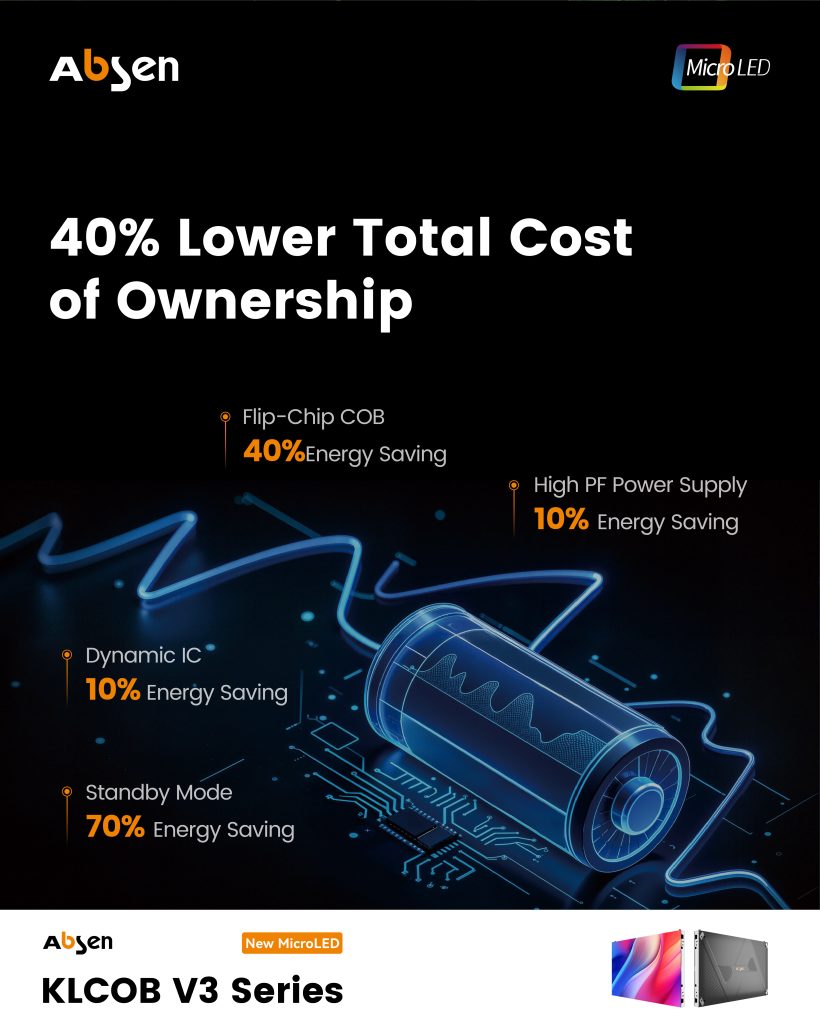
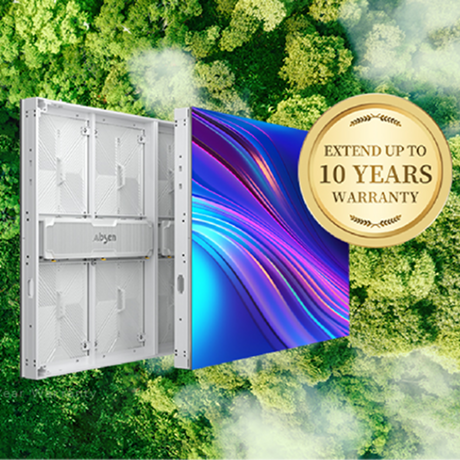
Absen’s best-selling KLCOB V3 Series – a new breakthrough in next-generation COB technology.
03 Addressing Real-World Scenarios, Differentiated Products Drive COB Large-Scale Adoption
The white paper notes that the industry still faces multiple challenges: severe product homogenization and insufficient differentiation for specific scenarios; intense price competition undermining core product value, with the industry urgently needing to shift toward competition based on image quality and comprehensive solution value; inconsistent product quality creating a strong demand for standardized quality assurance; and complex, installation and commissioning processes making ease-of-use upgrades an urgent priority.
Addressing these industry pain points, Absen builds its differentiated, scenario-based COB product portfolio around genuine market needs. It opened its COB products to global channels in 2022, and by 2025 had achieved full coverage across key application scenarios—including indoor fixed installations, outdoor advertising, and stage rental—with each product series optimized for its specific use case.
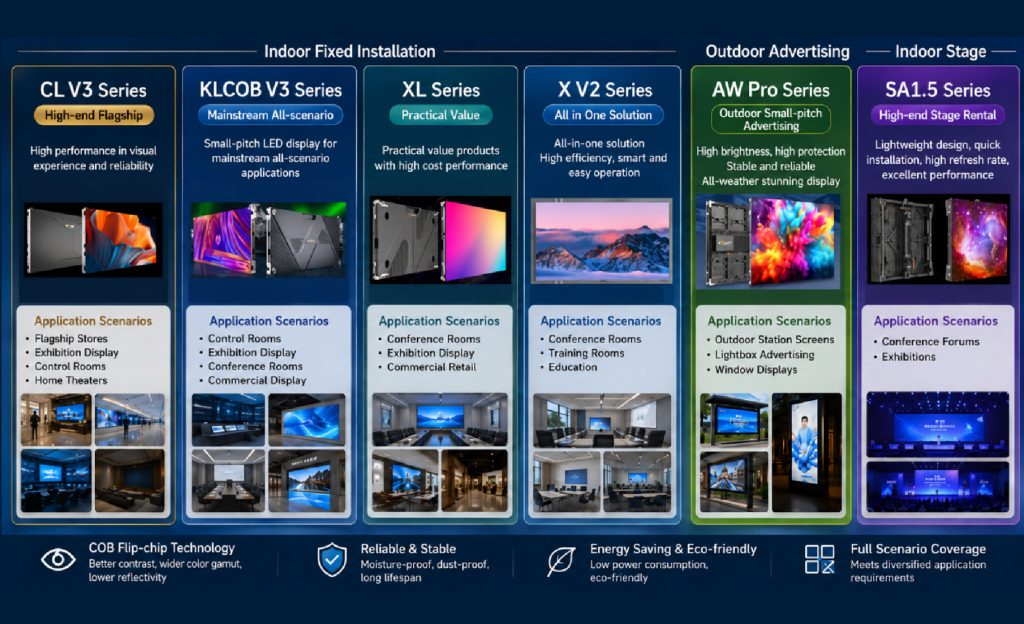
This offers an important lesson for the LED display industry: the large-scale adoption of COB is not simply about trading lower prices for higher volumes; technology, product capabilities, and scenario adaptability are all essential.
04 Benchmark Projects Validate Performance, Global Services Ensure Long-Term Support
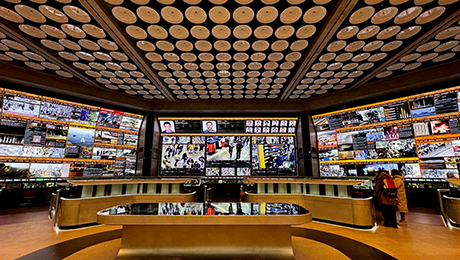
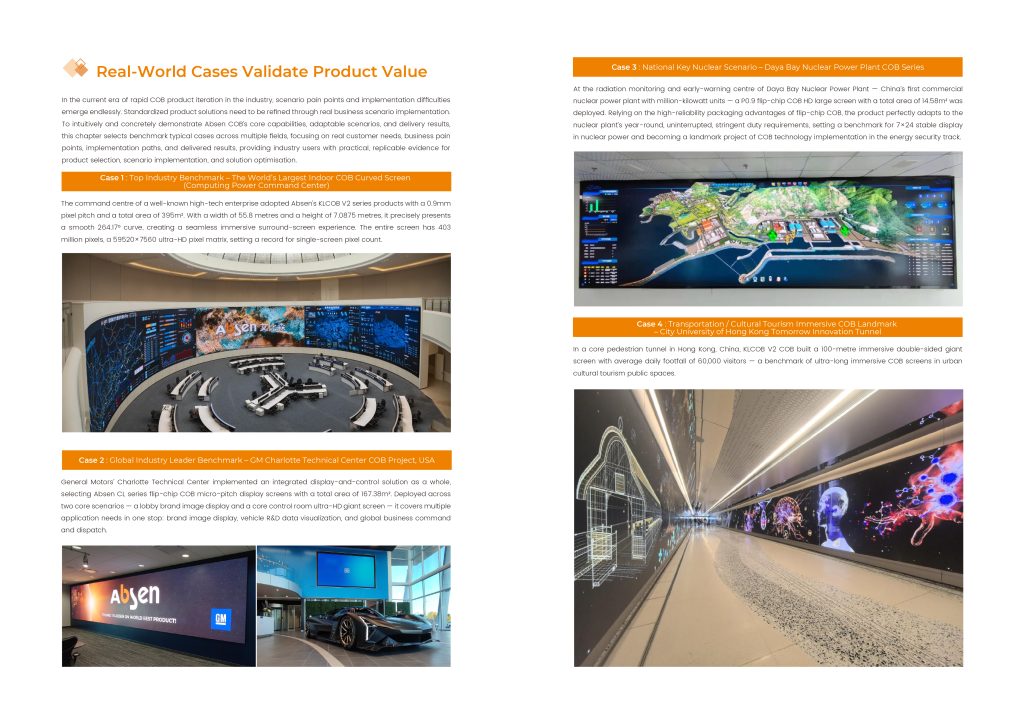
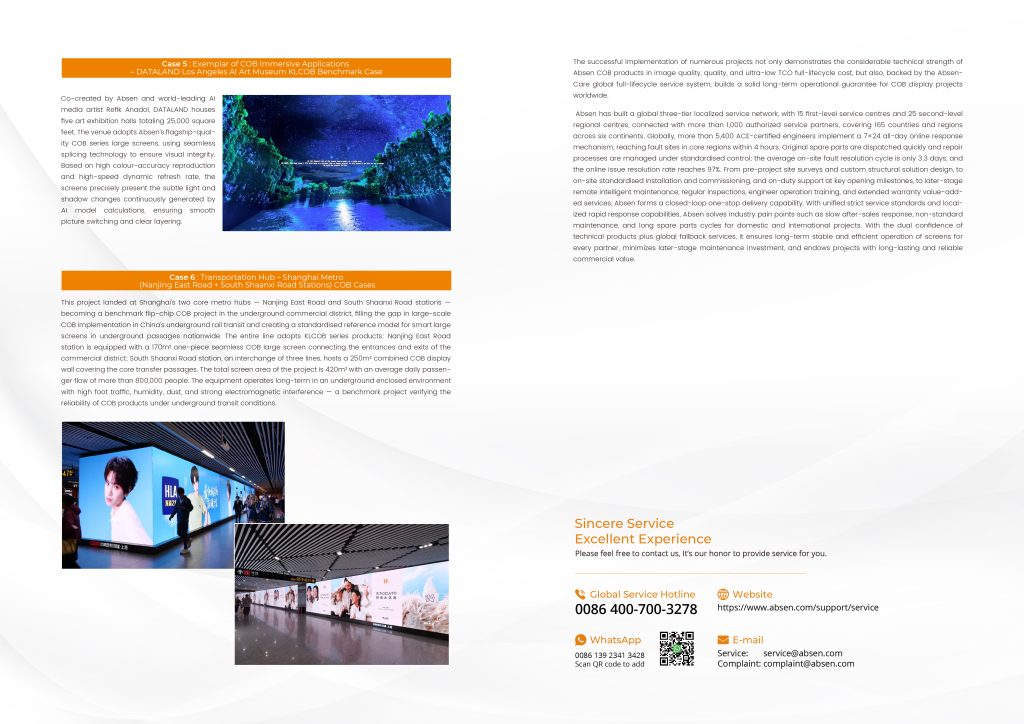
COB products are increasingly being deployed in high-reliability, high-complexity scenarios. However, only through long-term real-world validation can technical capability translate into the product reliability that customers trust. The white paper highlights six benchmark Absen projects spanning command and control, industrial R&D, nuclear power monitoring, public cultural spaces, AI art, and rail transit—demonstrating the maturity and scenario adaptability of Absen’s COB technology.
This offers an important lesson for the LED display industry: the large-scale adoption of COB is not simply about trading lower prices for higher volumes; technology, product capabilities, and scenario adaptability are all essential.
04 Benchmark Projects Validate Performance, Global Services Ensure Long-Term Support
COB products are increasingly being deployed in high-reliability, high-complexity scenarios. However, only through long-term real-world validation can technical capability translate into the product reliability that customers trust. The white paper highlights six benchmark Absen projects spanning command and control, industrial R&D, nuclear power monitoring, public cultural spaces, AI art, and rail transit—demonstrating the maturity and scenario adaptability of Absen’s COB technology.